|

A YEAR OF THE QUIET SUN (Rok Spokojnego Slonca)
Germany/Poland / 1984 / 106 min's / col / directed by Krzysztof Zanussi
Golden Lion, Venice Film Festival 1984.
Golden Globe Nomination 1984 for Best Foreign Language Film
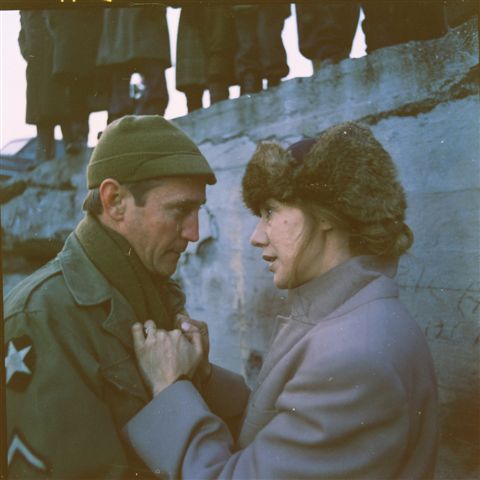
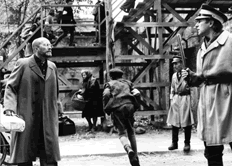
Poland - 1946, An American soldier visiting as part of a commission investigating crimes in a Prisoner of War camp falls in love with a Polish war widow amid the devastated countryside. In spite of the painful memories of their past, the language barrier and the many cultural divisions that separate them, Norman and Emilia dare to steal a moment of happiness amongst the misery of their surroundings.
Made during the period in the 1980's after the imposition of martial law and the banning of the Solidarity trade union, A Year Of The Quiet Sun is a multi-layered film where beneath the ostensibly routine wartime story there are many references and parallels to other historical events such as the Katyn massacres, that were strictly off-limits during the communist era where Poland was effectively a satellite state of the USSR.
When A Year of the Quiet Sun premiered at the Venice film festival, those unspoken sub-texts were clearly understood by key members of the international jury. One was Yevgeny Yevtushenko, whose own poem on Babi Yar and the massacre of Ukrainian Jews at Kiev had caused an uproar in the Soviet Union . Another was Günter Grass, who confirmed that Zanussi's film was the jury's favourite from the first days of the festival - and its unanimous choice for the Golden Lion.

A SCHOOLGIRL’S DIARY
North Korea / 2006 / 94 min’s / col / directed by Jang In-hak
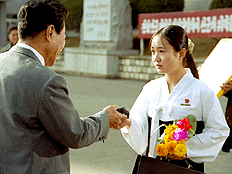
Su-ryeon a teenage schoolgirl is dissatisfied with her life, her family lives in a traditional house and she’s longs to live in the same modern apartment as her school friends. She resents her father’s long absences and her mother’s unquestioning loyalty to him. Eventually she comes to appreciate the sacrifices of her parents and resolves live her life according to their example.
A box office sensation in North Korea where according to official North Korean reports it had in excess of 8 million admission (a third of the population) A Schoolgirl’s Diary was the first film from North Korea for very many years to be widely seen internationally and to receive a full cinema release outside North Korea, in France in 2007 via Pretty Pictures.
The schoolgirl of the title could be regarded as the present day embodiment of the title character in The Flower Girl, living a life with modest comforts amongst loving family free of imperialist oppression.
See also. The Flower Girl and North Korean Cinema Collection
DESIRE WILL SET YOU FREE
Germany / 2015 / 92 min’s / in colour / HD / directed by Yony Leyser
Synopsis: A young American writer falls for a Russian hustler and introduces him to his alternative lifestyle amongst Berlin’s queer and underground scenes, but as they make their hedonistic journey through clubs and parties, their inner desires reveal themselves.
The film is the debut fiction feature of Yony Leyser who received widespread acclaim for his 2010 documentary profile "William S Burroughs: A Man Within"
I don’t want to show people what the world is like, I want to show people what the world can be, for all it’s dirty, sexual, crazy, campy and colourful potential.” - Yony Leyser
FLOWER GIRL, THE (Kotpanum Chonio)
North Korea / 1973 / 121 min’s / col
directed by PAK Hak and CHOE Ik-kyu
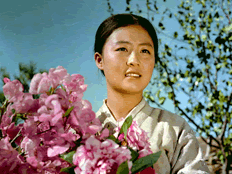
In a near feudal Japanese dominated Korea, a teenage girl spends her days selling flowers to try to help her widowed, overworked mother and blind younger sister whilst waiting for her departed brother to fulfil his promise to return and rescue them from their poverty.
Widely regarded as the best film ever made in North Korea and often labelled the “North Korean Gone with the Wind”, the Flower Girl is the filmed adaptation of an opera written by the “Great Leader” Kim Il Sung. It won a major prize at the 1973 Karlovy Vary Film Festival. The film depicts a Korea under imperial Japanese rule where servants are little more than chattels of their employers (with similarities to Japanese films such as Sansho Dayu). Typical of a cinema that seeks to celebrate revolutionary ideals, it was highly inspirational for communist idealists elsewhere.
See also North Korean Cinema and A Schoolgirl’s Diary
KORCZAK
Germany, Poland, France / 1990 / 113 min’s / b&w
directed by Andrzej Wajda
KORCZAK is best described through an extract from a letter from Stephen Speilberg to the Academy proposing him for a special Oscar; -
“Emblematic of Wajda's later career is Korczak (1990), one of the most important European pictures about the Holocaust. It is a moving drama of the legendary paediatrician and educator who wrote under the pen name Janusz Korczak, who fights a valiant but ultimately tragic battle to protect the 200 children in his care from the horrors of the Warsaw ghetto and deportation to the Treblinka death camp." Kevin Thomas, of the Los Angeles Times, called the film "Yet another triumph for Wajda, long regarded as one of the world's greatest directors" and concluded that "Not only is Korczak one of the great Holocaust films, but it is also a great film, period". The Wall Street Journal's reviewer wrote "Wajda has proven that saints do not have to be boring. His Korczak is brave, stubborn and wise".
For full text see www.andrzej.wajda.pl
NORTH KOREAN CINEMA COLLECTION
In association with Pretty Pictures, we present this unique selection of four films representing the best in North Korean cinema since the creation of the Democratic Peoples Republic of Korea. Although North Korea has been a fairly prolific producer of feature films since its creation in 1948, its output has been little seen internationally.
The recently deceased North Korean leader, Kim Jong Ill (the “Dear Leader”) was reportedly a life-long cinephile with a personal collection of 20,000 prints, videos and DVDs and wrote a book entitled On the Art of Cinema. He was clearly instrumental in creating a significant film industry that made films of a good technical standards displaying some genuine cinematic flair. They offer a rare insight into a unique society that has very little contact with the rest of the world.
This collection comprises A Schoolgirl’s Diary and The Flower Girl (see separate entries) which are available in all media in original and English subtitled versions for screening in international festivals and other media. At this time only original versions or French subtitled versions are available for A Bellflower (1987, 92 mins) and The Tale of Chun Hyang (1980, 147 mins).
north sea texas (noordzee texas)
Belgium / 2011 / 94 min’s / col / directed by Bavo Defurne
Montreal World Film Festival - FIPRESCI (critics) Prize for best First Film
Montreal World Film Festival - Silver Zenith, First Films Competition Jury prize
Rome Cinema Festival - Alice Nella Città 13+ Award
Cape Winelands Film Festival - Best New Director
Miami Gay & Lesbian Film Festival - HBO Jury Prize for Best Feature
London Lesbian & Gay Film Festival – Closing Film 2012
Mix Milan – Opening Film 2012
Pink Apple Gay & Lesbian Film Festival, Zurich – Opening Film 2012
Mix Brazil, Sao Paolo & Rio De Janeiro – Opening Film 2012
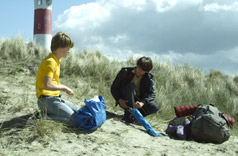
Pim lives with his ex-beauty queen, single mother in a small town on the Belgian coast. An introverted boy, Pim brightens up his days with drawing and dreaming up fantasy lives. He expresses his emerging desires through a secret collection of "borrowed" objects that he keeps in a shoebox.
With teenage years comes sexual awareness and he now draws and dreams of Gino, the older boy next door, his motorcycling hero. But this first love seems likely to end in disappointment.
Pim’s mother, Yvette, has dreams of her own. Tired of unwanted suitors and bored with small town life, she longs to leave everything behind and to see the world. Pim and Yvette’s dreams collide when handsome Zoltan arrives in town with the fun-fair and becomes their new lodger.
“a poignantly rendered coming-of-ager from tyro Belgian helmer Bavo Defurne. Delicately capturing the ecstasy of first love and the heartache of frustrated desire”…. “pic benefits from an artful combination of naturalistic performances and attractively stylized visuals, aided by judicious use of an evocative score”.
Alissa Simon, Variety
“small but perfectly formed dissection of first love in 1970’s Belgium… Bavo Defurne’s film has its comic turns, with some beautifully observed vignettes. A gem”
Harry Barnes, The Times (UK).
“It’s a film of supple visual flair and delicately acted appeal”
Tim Robey, Daily Telegraph (UK)
"The film is shot with such beauty and grace – there are many scenes where the eye is treated to a feast of picturesque images and sounds of seaside serenity.... And young Jelle Florizoone is magnificent as Pim"
Joseph Orr, Totally Dublin (Ireland)
YOU CAN’T ESCAPE LITHUANIA
Lithuania / 2016 / 80 mins / in colour / directed by Romas Zabarauskas
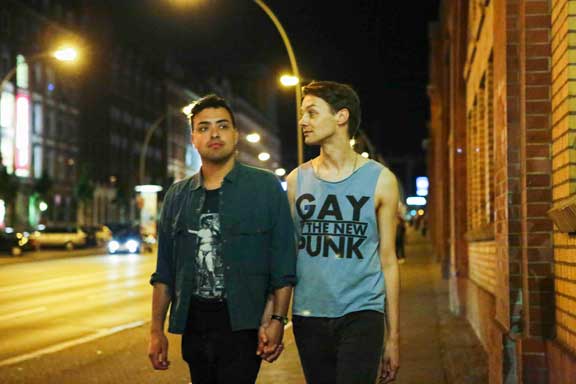
Synopsis: After his star actress, Indre, murders her mother, rich-kid filmmaker Romas plans her escape from Lithuania. His Mexican boyfriend Carlos helps them reluctantly. On the road, Romas begins shooting an improvised experimental film. As events take an unexpected turn, their secrets, memories and emotions make this journey wilder than any film Romas could have imagined.
This is young Lithuanian filmmaker Romas Zabarauskas’s second feature. After his short film Porno Melodrama which he directed at the age of 20 was selected for the 2011 Berlinale, he made his feature debut with We Will Riot in 2013. A well known LGBT activist in a country and region where attitudes are much less progressive than in Western Europe, Romas’s films wrestle with the complexities of life in a westward looking but still conservative society.
|
|